
· by Michael Blair, Nashville's HVAC
The first cool nights of the season are when gas furnaces get their fall tune-up, and every year some of those visits end with the same news: the heat exchanger is cracked, the furnace is unsafe, and it needs replacing now. That can be exactly right. A breached heat exchanger can let combustion gases, including carbon monoxide, into the air the blower sends through the house, and Lennox’s page on cracked heat exchangers describes that gas as colorless, odorless and potentially deadly. It is also a diagnosis that can be hard for a homeowner to check, which is why it is worth understanding what the part does and what real evidence of a crack looks like.
What the heat exchanger does
Inside a gas furnace, the burners fire into a set of sealed metal chambers. The flame and its exhaust stay inside those chambers and leave through the flue, while the house air is blown across the outside of the metal and picks up the heat without ever touching the combustion. Lennox describes the exchanger’s metal walls as what keeps gases like carbon monoxide separated from the indoor air while the heat passes through. Keeping the two apart is the whole job.
Every time the furnace runs, that metal heats up and expands, then cools and contracts when it shuts off, and Lennox says years of those cycles can weaken the metal until it cracks. Moisture is the slower threat. The same Lennox page names excess moisture in or around the furnace as a cause of corrosion in the exchanger walls, and the installation manual for Lennox’s EL180UHNE gas furnace warns that too little combustion air leaves excess water in the heat exchanger, resulting in rusting and premature failure.
What makes a heat exchanger fail early?
Heat is the enemy, and too little airflow is the usual source of too much heat. A clogged filter, closed or blocked supply registers, undersized return ductwork or a blower running at the wrong speed all let the metal run hotter than it was designed to. The Lennox manual ties this straight to the part: a furnace not adjusted to the temperature rise printed on its nameplate may see erratic limit operation and premature heat exchanger failure, and a filter with a high pressure drop can make the limit trip more often in winter. A high-limit switch that keeps shutting the burner off is a sign the metal is running hot. Size counts as well. Lennox notes that a furnace turning on and off too often takes on extra stress and that incorrect sizing can speed up wear on the exchanger, and our post on short cycling explains how an oversized system ends up doing that.
Age matters too, though we have found no source that puts a number of years on when a heat exchanger fails. A Department of Energy Building America study of gas furnaces at the end of their service life notes that furnaces can operate with little maintenance for 30 years or longer, and the older units it tested, averaging 19 years in service, showed no drop in efficiency. That study measured efficiency rather than cracks, but it is a fair reminder that the date on the label says little on its own. What a technician should be looking for is physical evidence on your unit, not a birthday.
What proves a heat exchanger is cracked?
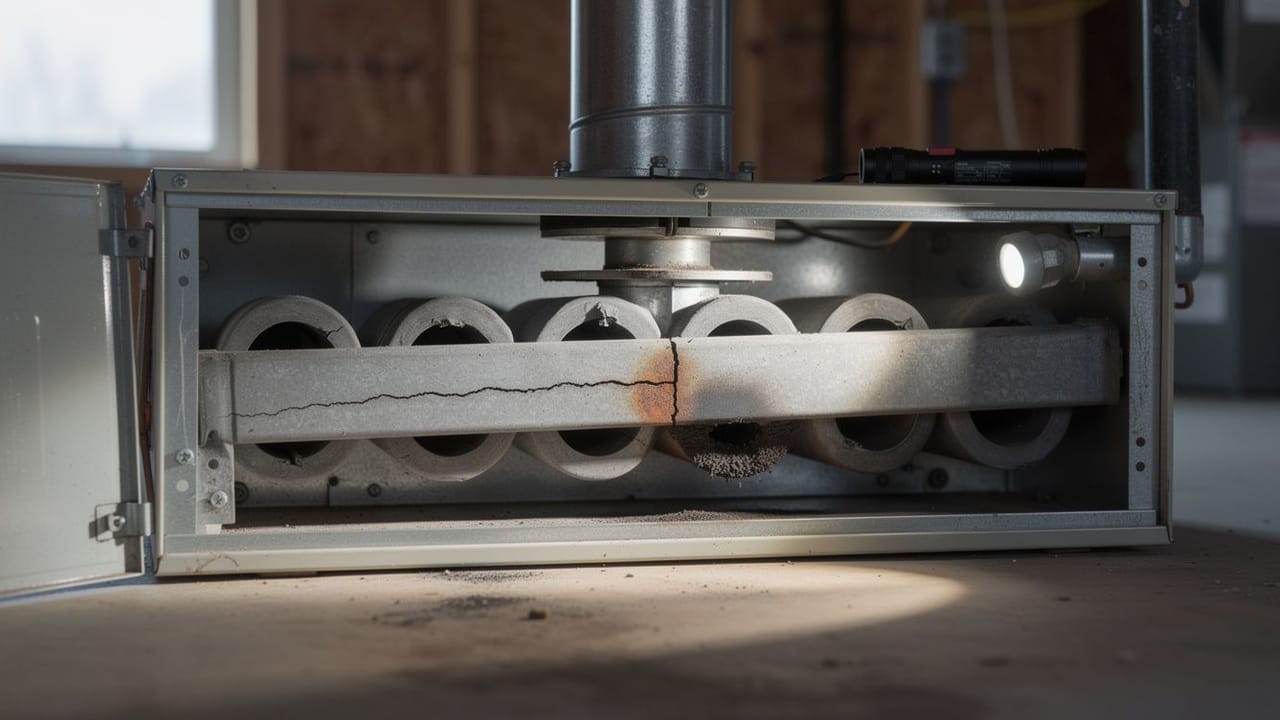
A crack you can see is the clearest proof. Lennox’s manual makes a heat exchanger check part of the yearly maintenance a licensed technician does at the start of each heating season, following the AHRI heat exchanger inspection procedure, and Lennox ties that annual check to its limited warranty. It is part of the fall visit in our maintenance plans. The Lennox consumer page lists visual inspection and combustion analysis among the ways a technician confirms a crack. If the crack was seen, ask for the photo or video. If it was measured, ask for the readings, and see either one before agreeing to anything. Visible rust or corrosion around the furnace or its flue pipes is on Lennox’s list of warning signs, along with excess soot around the burners or vents, which can mean incomplete combustion caused by a crack.
Indirect signs support the diagnosis without proving it on their own. According to Lennox, a carbon monoxide detector that alarms or reads above 30 ppm may mean a cracked exchanger, and so may short heating cycles or a burning, metallic or chemical smell from the furnace. The word there is may. We treat a single reading, taken without knowing how the furnace was running at the time, as a reason to look harder. Several signs pointing the same way, or a photograph of the crack, is what makes the case.
- Ask for a photo or video of the crack itself
- Ask which test was used and what the readings were
- Get the model and serial number written on the report
- Get a second opinion before paying for a replacement
What to do if the furnace is tagged
If you suspect a crack, Lennox’s advice is to shut the furnace off, open doors and windows, and call an HVAC professional. If a technician has already shut it off and tagged it unsafe, leave it off until it has been repaired or replaced. Make sure your carbon monoxide alarms work while you sort it out: Tennessee’s State Fire Marshal’s Office says to install them outside each sleeping area and on every level of the home, and the EPA says each floor needs its own detector. To get through a cold night, the CDC’s winter safety tips say never to heat the house with a gas oven or burn anything in a stove or fireplace that is not vented.
Then check the paperwork. At both Lennox and Trane the heat exchanger carries longer coverage than the rest of the furnace, though the term depends on the brand and model. Lennox’s warranty page lists 20 years or a limited lifetime on the heat exchanger depending on the model, with registration required within 60 days of installation for its extended coverage, and labor included only if the owner chooses an alternative plan when registering. Trane’s guide to its warranties gives 20 years on a furnace heat exchanger whether or not the unit was registered, and says labor is covered under neither its base nor its registered warranty. That can make replacing the part itself worth weighing on a newer furnace. On an older one, Lennox notes that the age of the system or other damage from the crack can make replacing the whole furnace necessary, and that is a system replacement sized to the house. When our crews find a crack on a furnace repair call, we photograph it and leave the report with the model and serial number on it, so the next technician you call can confirm it or tell you otherwise. If you have been given this diagnosis and want a second look, ask us for a free written estimate.
Sources
- Lennox, Furnace Cracked Heat Exchanger — Carbon monoxide can escape through a crack; the exchanger walls separate combustion gases from indoor air; expansion and contraction, poor airflow, short cycling, sizing and moisture as causes; warning signs (CO alarm above 30 ppm, soot, rust, odors, short cycles); visual inspection and combustion analysis; shut the furnace off; age can make a whole-furnace replacement necessary
- Lennox Industries, EL180UHNE Gas Furnace Installation Instructions (507647-05, 04/2024) — Insufficient combustion air causes excess water, rusting and premature heat exchanger failure; temperature rise outside the nameplate range causes erratic limit operation and premature failure; filter pressure drop trips the limit; annual heat exchanger check per the AHRI procedure, tied to the Lennox limited warranty
- U.S. Department of Energy Building America (PARR), Improving Gas Furnace Performance: A Field and Laboratory Study at End of Life, 2015 — Furnaces can operate with little maintenance for 30 years or longer; older furnaces averaging 19 years showed no efficiency degradation
- Tennessee State Fire Marshal’s Office, Safety Tips on Carbon Monoxide Awareness Day, 2018 — CO alarms outside each sleeping area and on every level of the home
- U.S. EPA, Where should I place a carbon monoxide detector? — Each floor of the home needs a separate detector
- CDC, CDC Offers Winter Safety Tips, 2021 — Never heat the house with a gas oven or burn anything in an unvented stove or fireplace
- Lennox, Lennox Product Warranty — 20 years or limited lifetime on the heat exchanger depending on model; registration within 60 days; labor only through the alternative coverage option
- Trane, Trane Warranties Explained, 2024 — Furnace heat exchanger 20 years under both base and registered warranties; labor not covered; registration within 60 days
FAQ
Told Your Furnace Has a Cracked Heat Exchanger — questions
How can I tell if my furnace really has a cracked heat exchanger?
Ask for the evidence: a photo or camera video of the crack, and the readings from any combustion or carbon monoxide test. A diagnosis based on one reading or on the furnace’s age alone is worth a second opinion before you replace anything.
Is it safe to run a furnace with a cracked heat exchanger?
No. A breach can let combustion gases, including carbon monoxide, into the air circulated through the house. Once a crack is confirmed, the furnace should stay off until it is repaired or replaced, and carbon monoxide alarms should be working outside each sleeping area and on every level of the home.
Is a cracked heat exchanger covered by warranty?
Often the part is. Lennox lists 20 years or a limited lifetime on the heat exchanger depending on the model, and Trane lists 20 years whether or not the furnace was registered. Labor is usually not included. Both brands set a 60-day registration window for their extended coverage, so check the registration using the furnace’s model and serial number.
Can a cracked heat exchanger be repaired?
The fix we weigh is replacement, of either the heat exchanger or the whole furnace. On a newer furnace, Lennox and Trane cover the exchanger for 20 years or longer depending on the model, though labor usually isn’t included, so replacing the part can make sense. On an older one, age or other damage can make a new furnace necessary.