
· by Michael Blair, Nashville's HVAC
The call usually comes in the late afternoon. The air conditioner has been running since lunch, air is coming out of the vents, and the thermostat still reads several degrees above where it is set. Plenty of things produce that, from a filter nobody changed to a refrigerant leak, and the fix runs from free to expensive. Guessing wastes money in both directions: people pay for a service call to learn the thermostat was on Fan, or they keep running a system that is damaging itself. This is the order we work through it on an AC repair call, with the steps a homeowner can safely take marked out from the ones that belong to a licensed technician.
What should I check first when the AC runs but the house will not cool?
Check the thermostat and the filter first, because they cost nothing and between them they explain a good share of these calls. At the thermostat, the mode should say Cool, not Fan or Heat, and the setting should be below what the room actually reads. Then look at the fan setting. On On, the indoor blower runs nonstop and keeps pushing air through the vents in the stretches when the outdoor unit is resting, and that air feels warm. Set it to Auto. If the display is blank or flickering on a battery model, replace the batteries before reading anything else into it.
Then pull the filter. ENERGY STAR’s guidance on heating and cooling says a dirty filter slows airflow and makes the system work harder, and that a filter should be checked monthly in the heavy-use months, changed when it looks dirty, and changed every three months at the least. A filter caked gray will choke the air moving across the indoor coil, and in a humid Nashville July that is often how a coil ends up iced. Put a clean one in with the arrow pointing toward the unit, give the system time to settle, and see whether the vents get colder.
Is the outdoor unit running, or is it silent?
Walk outside while the thermostat is calling for cooling, because the answer splits the problem in two. A running outdoor unit has its top fan turning and a steady hum from the compressor inside. If the fan is still, the unit is quiet and the indoor blower is pushing air anyway, the house is getting air that has never been cooled.
A silent outdoor unit is usually an electrical problem. Check the breaker for the air conditioner in the main panel and the disconnect box on the wall beside the unit. If the breaker has tripped, reset it once. If it trips again, leave it off and call, because a breaker that keeps tripping is telling you something in the circuit or the unit is wrong. Electrical work inside the unit is not a homeowner job. ENERGY STAR’s maintenance checklist lists tightening the electrical connections and measuring voltage and current on the motors as contractor tasks, and warns that faulty connections can make the system unsafe to run.
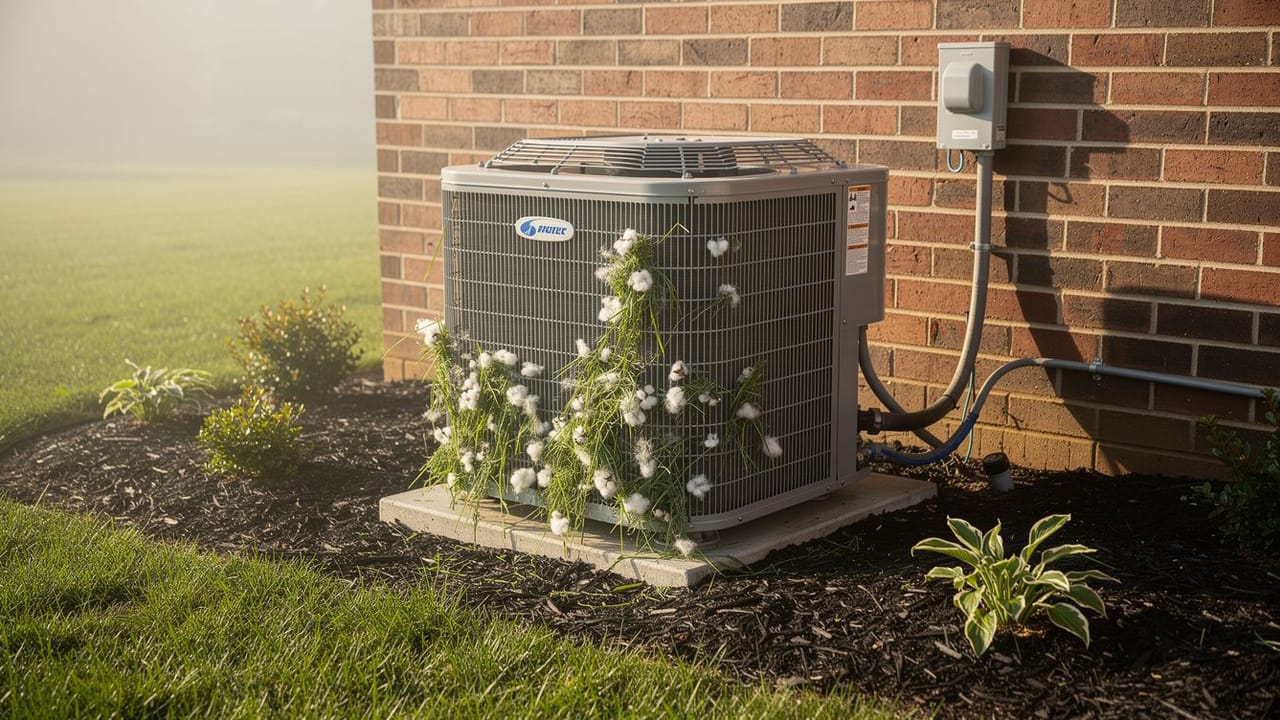
If the outdoor unit runs but the house still will not cool, look at its coil, the fins around the sides. The same ENERGY STAR checklist says dirty coils reduce the system’s ability to cool the house and make it run longer. Around here that means cottonwood fluff and pollen in late spring, grass clippings blown at it all summer, and leaves against the north side by fall. With the power off at the disconnect, you can pull loose debris and clippings off the outside by hand and trim back shrubs crowding the unit. A coil matted deep in the fins needs a proper cleaning on a service visit, not a pressure washer.
What do ice, water and weak air at the vents tell you?
Ice on the copper line at the outdoor unit or on the indoor coil means the coil has frozen, and a frozen coil cannot cool. Switch cooling off at the thermostat and let it thaw before anyone tries to diagnose it, since nothing can be read through the ice. The usual causes are airflow and refrigerant charge, and our post on why an air conditioner freezes up goes through how we tell the two apart.
Water on the floor around the indoor unit, or in the pan under an attic air handler, points at the condensate drain. ENERGY STAR’s checklist says a plugged drain can cause water damage in the house and affect indoor humidity, and many systems have a float switch that shuts the cooling down when the pan fills. If the house feels damp and warm at once, that is worth reading alongside our post on why a house feels clammy at 72 degrees.
Then put a hand to the registers. Strong airflow from every vent that just is not cold points back toward the equipment. Weak air everywhere points at airflow: the filter again, the blower, or the ductwork. ENERGY STAR’s checklist says airflow problems can cut a system’s efficiency by up to 15 percent, and its heating and cooling page says sealing and insulating ducts can improve efficiency by as much as 20 percent, starting with ducts in the attic, crawl space, unheated basement or garage. In a house with ducts in a vented crawl space or a hot attic, much of the cooling can be lost before it reaches a room. If only one room lags, that is a different problem, covered in our post on the room that is always hotter, and our ductwork and sealing work handles the duct side of both.
Which part of this needs an EPA 608 certified technician?
Anything involving the refrigerant does, and that is where a homeowner’s part of this stops. The EPA’s Section 608 technician certification requirements say technicians must pass an EPA-approved test to be certified, and the EPA’s definition of a technician covers anyone who attaches or detaches hoses and gauges to measure pressure, or adds refrigerant to or removes it from an appliance. Checking the charge, finding a leak and recharging the system all fall inside that definition. The EPA also lists the types of certification a technician can hold, and it is fair to ask which one the person at your door has.
Refrigerant runs in a closed loop and is not used up the way fuel is, so a system that is low has a leak somewhere. ENERGY STAR’s checklist puts checking the refrigerant level and adjusting it on the contractor’s list, and notes that too much or too little makes the system less efficient. A top-up with no leak search buys a few weeks at best. On our AC repair calls, the technician reads the charge, looks for where it went, tests the electrical parts in the outdoor unit, checks the blower, and tells you in writing whether the fix is a repair or whether the system has reached the point where replacing it is the better spend.
Timing matters too. ENERGY STAR’s checklist suggests having the cooling side checked in spring, because contractors get busy once the heat arrives, and a July heat wave across Murfreesboro, Spring Hill and the rest of Middle Tennessee bears that out. A maintenance plan puts that visit on the calendar. If your system is running and losing ground right now, work through the steps above, then send us what you found, including what the outdoor unit was doing, and we will price the repair before any work starts.
- Thermostat on Cool, setpoint below the room, fan on Auto
- Filter checked and changed if dirty
- Outdoor unit running or silent while the thermostat calls for cooling
- Breaker and disconnect checked, reset no more than once
- Loose debris cleared from the outdoor coil with the power off
- Ice on the lines or coil, water at the indoor unit, airflow at the vents
- Refrigerant, gauges and electrical testing left to a certified technician
Sources
- ENERGY STAR, Maintenance Checklist — Dirty coils reduce cooling and lengthen runtime; refrigerant level, electrical connections and blower airflow (up to 15 percent) as contractor tasks; plugged drains; check cooling in spring before contractors get busy.
- ENERGY STAR, Heat & Cool Efficiently — Check the filter monthly in heavy-use months and change it at least every three months; duct sealing and insulation can improve efficiency by as much as 20 percent, attic and crawl space first.
- U.S. EPA, Section 608 Technician Certification Requirements — Technicians must pass an EPA-approved test; attaching gauges to measure pressure or adding or removing refrigerant makes a person a technician.
- U.S. EPA, Types of Technician Certification — The categories of Section 608 certification a technician may hold.
FAQ
AC Running but Not Cooling: The Order to Check It — questions
Why is my AC fan running but the air is not cold?
Either the outdoor unit is not running while the indoor blower moves air, or the system cannot remove heat. Check that the thermostat fan is on Auto rather than On, change a dirty filter, then see whether the outdoor unit is running. A silent unit is usually electrical; a running one points at the coil, airflow or refrigerant.
Can I add Freon to my AC myself?
No. The EPA counts anyone who attaches gauges to measure pressure or adds refrigerant to an appliance as a technician, and technicians must pass an EPA-approved Section 608 test. Refrigerant is also not used up, so a low system has a leak. Adding more without finding that leak only delays the same problem.
Should I turn off my AC if it runs but does not cool?
Turn it off if you see ice on the lines or coil, if the outdoor unit stays silent while the indoor blower runs, or if the breaker trips a second time. Otherwise, make the thermostat and filter checks first. A system left running all day without cooling uses power, wears the equipment and fixes nothing.
Why does my AC run all day and the house stays warm?
It is losing the cooling somewhere: a dirty filter or coil, weak airflow, leaky ducts in a hot attic or crawl space, or a refrigerant leak. ENERGY STAR notes that dirty coils make a system run longer and that sealing ducts can improve efficiency by as much as 20 percent. Work from the cheap checks toward the technical ones.
Can a dirty outdoor unit make my AC blow warm air?
Yes. The outdoor coil is where the heat from your house is released, and ENERGY STAR says dirty coils reduce a system’s ability to cool and make it run longer. With the power off at the disconnect, clear loose clippings, leaves and cottonwood by hand. A coil packed deep in the fins needs a cleaning on a service visit.