
· by Michael Blair, Nashville's HVAC
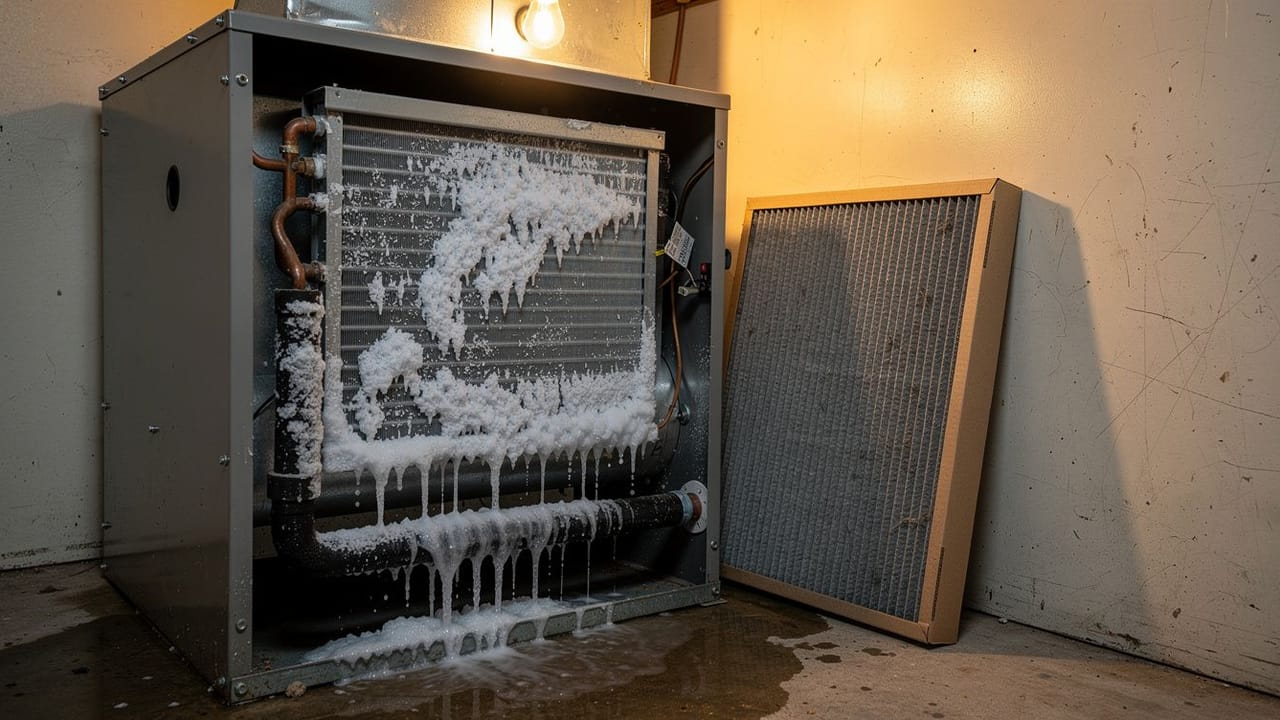
Ice on the indoor coil or the line set during a Middle Tennessee August feels like a contradiction. Lennox’s page on why an AC freezes up explains it: when airflow is reduced, the evaporator coil gets too cold, and the humidity in the air condenses on it and freezes. Trane’s frozen evaporator coil troubleshooting page counts frozen refrigerant lines at the outdoor unit among the signs, so ice on the copper outside belongs to the same problem.
What usually makes an air conditioner freeze up?
Trane calls restricted airflow the biggest reason an evaporator coil freezes, and a clogged or dirty filter is the first cause on its list. Lennox gives the mechanism: less warm air reaches the coil, so the coil’s temperature drops until it ices over. That is why the filter is the first thing we pull on an AC repair call, before any gauges go on.
Closed or blocked vents do the same thing. Lennox puts blocked ducts in the same category and names furniture, rugs and curtains as what usually covers the vents; Trane adds blocked return air vents. A duct run that has been crushed or disconnected is something we check on the same visit, and the fix belongs to our ductwork and air quality work. One room that never cools, with no ice anywhere, is its own problem, and our post on why one room is always hotter deals with it.
One cause has nothing to do with the house at all. Lennox warns that running the AC when it is below 60°F outside can freeze it, so a cool spring or fall night with the thermostat still set to cool is worth remembering if the ice shows up in April or October.
Then the coil itself
Trane lists a dirty evaporator coil among the causes of restricted airflow, next to the filter. The coil sits out of sight inside the air handler, so its condition goes unnoticed until someone takes the panel off. Trane’s answer is a service visit every spring that includes cleaning the coils, and our maintenance plans book two visits a year for anyone who would rather not keep track.
Coils are behind the filter for a reason. When we find a dusty coil behind a filter that has been changed on schedule, we look at how that filter fits its slot. Honeywell Home’s air cleaner page makes the point that a snug fit is what sends air through the filter instead of around its edges.
Refrigerant, and what low means
Low refrigerant drops the pressure in the coil, and according to Carrier’s page on home AC recharges, that pressure drop takes the coil below freezing. Carrier also explains that the refrigerant circulates in a closed loop and is not used up, so a system that is low has a leak. Trane allows one other explanation, a system that was charged wrong when it was installed.
Carrier says the leak has to be found and sealed before more refrigerant goes in. The one exception its technician allows is a small leak that cannot be located even after a thorough inspection, where adding a little and monitoring it may be reasonable. So ask what was done to find the leak, and get the recharge priced separately from the repair. More is not better either: Carrier warns that overcharging can cause liquid slugging, which destroys the compressor.
- Change the filter, and make sure it fits its slot without gaps
- Open every supply vent and clear whatever is blocking the returns
- Look at the coil for a coat of dust
- Keep shrubs and growth back from the outdoor unit; Trane says at least two feet
- If the ice comes back after the filter is changed and the airflow is restored, have the refrigerant and the coil checked for a leak, which is what Lennox recommends
What should you do while the AC is frozen?
Switch the thermostat from cool to off. The manufacturers differ on the fan: Trane simply says to turn the system off, while Lennox says to set the fan to On with no cooling so house air moves across the coil and melts the ice faster. Either is fine. How long it takes depends on how much ice there is, and Trane and Lennox both mention water pooling as it thaws, so put a towel down around the indoor unit. Do not chip at the ice; Trane warns that can damage the coil.
Do not run cooling while it is iced. Trane says running with a frozen coil can cause major damage to the system, and the compressor is the part Carrier calls the most expensive in it. Once it has thawed and the filter is sorted, run it and watch the line set. If the ice is back the next day, ask us for a free written estimate and we will look for the cause, refrigerant included.
Sources
- Trane, Help! My AC Evaporator Coil Is Frozen — Restricted airflow the biggest reason, filter first; dirty coil and blocked returns; frozen lines at the outdoor unit; switch from cool to off; do not chip the ice; major damage if run frozen; puddles on thawing; low charge means a leak or a bad install charge; spring service with coil cleaning; landscaping two feet from the outdoor unit; filter every 1 to 3 months
- Lennox, Why Is Your AC Unit Freezing Up? — Reduced airflow makes the coil too cold and humidity freezes on it; blocked ducts and vents, furniture, rugs and curtains; below 60°F outside; fan on without cooling to thaw; pooling water; leak check if icing persists; filter every 1 to 3 months, more often with pets or allergies
- Carrier, What Is a Home AC Recharge? — Low refrigerant lowers pressure and coil temperature below freezing; closed loop, low means a leak to be found and sealed first; a monitored small top-up when a small leak cannot be located; overcharging causes liquid slugging; compressor the most expensive component
- Honeywell Home, Air Cleaners — A snug filter fit sends air through the filter, not around it; its media filters rated for up to 12 months
FAQ
Why Your Air Conditioner Freezes Up — questions
How often should I change my filter in Nashville?
Trane and Lennox both say every one to three months, and Lennox says more often if you have pets or allergies. Thicker media filters last longer; Honeywell Home rates its own for up to 12 months, so go by the maker’s label on the one you have. Whatever the interval, the filter has to fit its slot, or air slips around it.
Can I pour hot water on a frozen coil?
We would not. Trane warns against chipping at the ice because it can damage the coil, and we treat hot water the same way: let the ice melt on its own. Turn the cooling off, and if you want it faster, Lennox suggests running the fan with no cooling. Thick ice can take hours.
Is a frozen AC dangerous?
To the equipment, yes. Trane says running a frozen coil can cause major damage, and the compressor, which Carrier calls the most expensive part of the system, is what you stand to lose. The house is at risk from water rather than ice, since Trane and Lennox both mention puddles as it thaws. Shut cooling off as soon as you see ice.
Can low refrigerant freeze an AC coil?
Yes. Low refrigerant lowers the pressure in the evaporator coil and takes it below freezing. Because refrigerant circulates in a closed loop and isn’t used up, a low charge means a leak, or a system charged wrong at installation. Carrier says to find and seal the leak before adding more, and overcharging brings its own damage.