
· by Michael Blair, Nashville's HVAC
A heat pump in heating mode pulls heat out of the outdoor air, and to do that the outdoor coil runs colder than the air around it. Oak Ridge National Laboratory’s review of defrost technologies says frost builds on that coil when the outdoor air is between about 19 and 41°F and the relative humidity is above 65 percent, and the National Weather Service office in Nashville puts our normal January low at 30.1°F. So on a damp Middle Tennessee morning that coil frosts over. The defrost cycle clears it, and from inside the house that cycle looks and sounds alarming the first time you notice it.
What does a heat pump’s defrost cycle do?
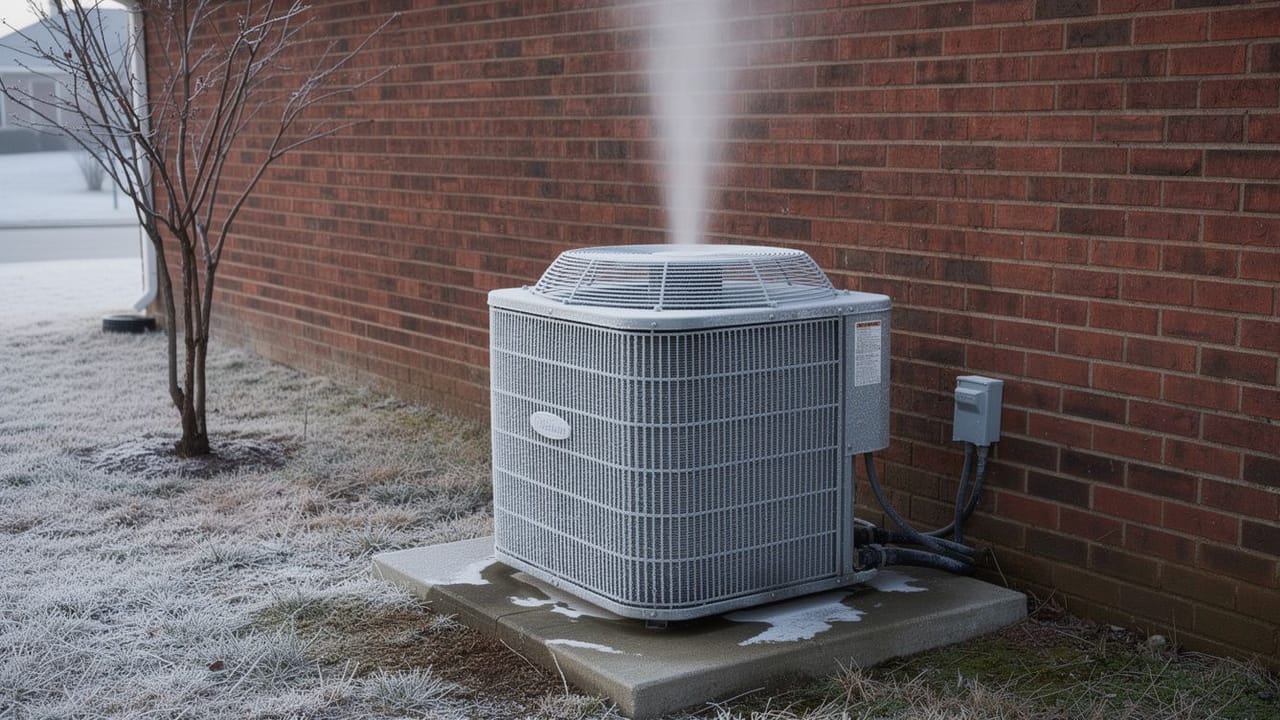
When the outdoor coil ices up, the system briefly runs itself as an air conditioner, sending hot refrigerant to the outdoor coil to melt the frost. Reversing the refrigerant cycle is the usual way heat pumps defrost, according to the Department of Energy’s 2024 peer review on defrost energy use. In Rheem’s owner and installation instructions for a two-stage heat pump, the outdoor fan and the compressor both shut off when defrost begins, the compressor restarts about 30 seconds later to warm the coil, and once the ice has melted some steam may rise from the unit as the warm coil dries off. That steam is what gets mistaken for smoke.
Inside, the air from the registers goes cool while it runs, because the Oak Ridge review notes that reverse-cycle defrost draws much of its heat from the indoor air. Depending on how the thermostat and controls are set up, some systems bring on the backup heat strips during defrost to cover that gap. When the coil is clear, Rheem’s sequence starts the outdoor fan again and pauses the compressor for another 30 seconds or so before heating resumes. How often it happens depends on the control: that Rheem board offers timer settings of 30, 60 and 90 minutes, picked by climate, with 30 recommended for moist Seattle and 90 for dry southern Arizona, and its defrost sensor closes at 32°F. A unit set like that can defrost after every half hour of running on a damp morning near freezing, and newer controls decide in their own ways.
Normal versus not normal
Normal: a coating of white frost on the outdoor coil that clears when the unit defrosts, which Rheem’s instructions describe as normal, a cloud of steam while the coil warms, cool supply air while the cycle runs, and water draining out of the base onto the pad afterward.
Not normal, and the things we treat as a service call: a solid block of ice encasing the coil that never clears, ice building on the top or the fan blades, a defrost that runs constantly or never runs, or supply air that stays cool long after the outdoor fan has started again. Trane’s heat pump maintenance page says the defrost cycle handles minor icing, and its service checklist covers the defrost control, the outdoor fan motor and debris on the coil. Those are where we start looking: a failed defrost control or sensor, an outdoor fan that is not turning, or a coil packed with leaves and dirt that has stopped air moving through it. Our heating repair page covers the rest of what we see on cold-weather calls.
- Light frost that clears: normal
- Solid ice that stays: a problem
- Steam during defrost: normal
- Ice on the fan or the top of the unit: a problem
Where does a heat pump’s defrost water go?
Every defrost cycle melts ice that has to drain out of the base of the unit. Trane’s heat pump installer’s guide says the pad must be level and high enough above grade for drainage, and Trane’s maintenance page raises the unit 4 to 8 inches off the ground and has the base-pan drain holes cleared of debris. If the pad has settled so it tilts, or leaves have blocked those holes, the water collects and refreezes in the base, and Trane warns that ice there restricts air flow. A unit sitting in a low spot that collects runoff has the same problem.
Check that the unit is level, raised off the ground on its pad, and clear of leaf litter and mulch at the base. Trane also says not to let the outdoor unit sit under a leaking gutter, since a steady drip can coat it in ice that has nothing to do with the refrigeration circuit at all. The other outdoor chores worth doing each year are in our post on what HVAC maintenance actually needs doing.
Auxiliary heat and the bill
The backup heat strips are electric resistance heat, and they cost more to run than the heat pump. The Department of Energy’s Energy Saver guide calls backup electric-resistance heating the more expensive kind, and Rheem’s instructions warn that leaning on it in place of the heat pump for long periods raises the electric bill. If the thermostat shows aux or emergency heat for long stretches, or the winter bill jumps, the strips are doing more of the heating, and our comparison of a heat pump and a gas furnace explains why a poorly insulated house makes that worse.
When we are called about it, we look at the thermostat first, then at whether the heat pump is putting out what it should, then at how cold the week has been. The DOE guide says not to set back a heat pump’s thermostat by hand if that brings on the backup electric-resistance heat, and to use a smart or programmable thermostat built for heat pumps if you want setbacks. Without one, set the temperature and leave it rather than turning it up and down. If aux heat is on most of the time in ordinary winter weather, get in touch with us and have the system checked.
Sources
- Oak Ridge National Laboratory, A Critical Literature Review of Defrost Technologies for Heat Pumps and Refrigeration Systems (ORNL/TM-2018/1007, 2018) — Frost forms on the outdoor coil at about -7 to 5°C (19 to 41°F) with relative humidity above 65 percent; reverse-cycle defrost takes much of its heat from indoor air
- National Weather Service Nashville, Winter Outlook for Middle Tennessee (2024) — Nashville normal January low of 30.1°F
- U.S. Department of Energy, Building Technologies Office 2024 Peer Review, Quantifying and Reducing Defrost Energy Use (Woods and Huang, NREL) — Frost forms on the outdoor coil in heating; defrost typically reverses the refrigerant cycle, running the heat pump as an air conditioner
- Rheem, Outdoor Heat Pump Two Stage R-410A Split System, User’s Information and Installation Instructions (2004) — Fan and compressor shut off at defrost start, 30-second compressor delays, steam may rise, frost is normal; 30/60/90-minute timer chosen by climate, sensor closes at 32°F; sustained strip heat raises costs; EM. HT. only for a suspected outdoor unit problem
- Trane, Home Heat Pump Maintenance — Defrost handles minor icing; elevate 4 to 8 inches; clear base-pan drain holes; not under a leaking gutter; water may freeze and restrict air flow; check defrost control and condenser fan motor
- Trane, Installer’s Guide, Heat Pumps (18-BC88D1-1, 2012) — The pad must be level and high enough above grade for drainage
- U.S. Department of Energy, Energy Saver: Tips on Saving Money and Energy in Your Home (2022) — Backup electric-resistance heat is more expensive; do not set back a heat pump manually if it brings on that heat; use a thermostat suited to heat pumps
FAQ
Why Your Heat Pump Steams and Blows Cool Air — questions
Is it normal for a heat pump to smoke in winter?
What looks like smoke is usually steam. During defrost the outdoor coil warms to melt its frost, and some of that water evaporates off the warm coil and rises from the unit. It is part of a normal defrost and shows up most on damp mornings near freezing. If you smell burning, or the smoke keeps coming after the outdoor fan has started again, shut the unit off at the breaker and call a technician.
Should I turn my heat pump to emergency heat when it is very cold?
Generally no. Emergency heat locks the outdoor unit off and heats the house with the backup electric strips alone, which cost more to run than the heat pump. Rheem’s instructions reserve that setting for a suspected problem with the outdoor unit. Use emergency heat when the heat pump itself has failed and you are waiting on a repair.
How much ice on a heat pump is too much?
A thin coat of frost that clears during each defrost cycle is expected. Ice that thickens over hours, encases the coil, or reaches the fan blades is not, because ice that heavy restricts the air moving through the unit. Switch the thermostat to emergency heat so the outdoor unit stays off, and have it looked at.
How do you protect a heat pump in winter?
Keep the outdoor unit level and raised, Trane suggests 4 to 8 inches off the ground, so defrost water drains away instead of refreezing in the base. Clear leaves and mulch from around it and keep the base-pan drain holes open. Make sure no leaking gutter drips onto it, since a steady drip can coat the unit in ice.